
For small and mid-sized founder-led companies, deciding where to put the next marketing dollar is rarely straightforward. Unlike large corporations, these companies don’t have the budget (or even the need) to spread investment across every channel. Instead, their focus should be on investing in the right B2B marketing programs that will get the right prospects to notice them, provide clarity in what they offer, and ultimately, start a conversation.
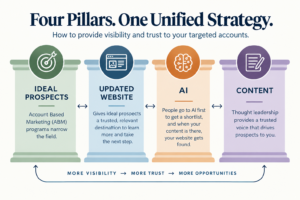
To achieve these results, 4 interwoven marketing investments are increasingly rising to the top, especially for founder-led companies:
- Account-based marketing (ABM)
- Website refreshes to tell a better story
- Visibility in AI-powered search
- Authority built through thought leadership
There’s also another investment that is always in the mix: founder-led networking. Read more about that here.
Here’s where founders are focusing marketing, and why it makes sense.
1. ABM: Focus on the Prospects that Matter
More leads aren’t necessarily better leads. Targeting the types of companies that fit your ideal client profile (ICP) can be a much more efficient use of marketing budget than trying to reach everyone. One of the marketing strategists on our team refers to the latter approach as “spray and pray” which is truly what it can feel like.
Account-based marketing flips traditional wide-net marketing on its head. Instead of creating campaigns designed to attract as many people as possible, you identify the companies you most want to work with and build marketing targeted to them.
That means highly relevant content is placed on a very intentional path that speaks to your ICP personally. For example, a customized path could include cultivating relationships through LinkedIn, personalized emails and direct mail, targeted advertising, invitation-only events, and other curated tactics meant to create connection and conversation.
The real benefit is focus. A founder-led business can laser-focus its limited resources on 25, 50 or 100 prospective clients rather than hoping the right person finds them.
And, because the outreach is designed around a specific audience, it can be much more relevant because it speaks to their unique challenges and priorities.
2. A Website that Resonates
Before reaching out to anyone, a prospect’s first step is likely to look at your website. So, your website is often doing the job of your salesperson before you ever know a prospect is interested. It needs to quickly answer three questions: Do you solve my problem? Would I like to work with you? And why should I trust you?
As the first point of entry for a prospect that needs your product or services, your website should make your proposition sharp, your differentiation crystal clear, and your proof visible.
This is particularly important because your savvy prospects are doing their homework via AI first. They want to know who is leading and who fits their needs. They then visit the websites of their shortlist to further investigate each company’s expertise.
This means your website needs to resonate with both AI and your prospects.
If you haven’t refreshed your website since AI leapt to the forefront, it’s time to get an outside opinion to see if the story is accurate, clear, and being found by AI.
3. Being Found in AI Search
As I just mentioned, search behavior is changing rapidly and buyers are increasingly using tools like ChatGPT and other AI search platforms to research categories, compare suppliers, and build shortlists before the even visit a company’s website.
Forrester reports that 87% of B2B buyers consider generative AI conversational search a meaningful interaction, while G2’s 2026 research found that 51% of B2B software buyers now start search with an AI chatbot more often than Google.
This is what the new AEO, or Answer Engine Optimization (also called GEO, Generative Engine Optimization) is all about. It means being visible in AI-generated answers in order to become discoverable. We use tools like SEM Rush and Arvo to see what pages are being found by AI and what people are searching AI for. We know how to set up clients for success on the backend.
To become increasingly relevant in this AI world, companies need useful, specific, authoritative content that clearly answers the questions their prospects are asking. They also need external signals like reviews, expert commentary, and industry mentions, that help AI systems understand whether a company is worth recommending. Think of it as not just aiming to rank (as the world was in SEO Google searches), but rather, aiming to be the answer.
4. Building Authority Around the People Behind the Business
Key to becoming “the answer” in AI searches is building authority. For a smaller company, the founder’s voice is typically one of its most valuable marketing assets. Founder-led thought leadership and third-party validation are instrumental in a company’s overall visibility and trust-building efforts.
A strong point of view, shared consistently through LinkedIn, industry publications, blogs, guest articles, and events can build recognition that paid advertising struggles to achieve. Just as importantly, customer stories, case studies and testimonials provide the proof that turns visibility into credibility.
This is increasingly important in an AI-assisted buying journey. Buyers may discover you through an AI tool, but they still want evidence that you’re credible and right for them. B2B buyers increasingly rely on their colleagues and circles of influence to validate and de-risk decisions.
Bringing It All Together
These four investments work best together.
- ABM gets you in front of the right accounts.
- A strong website turns attention into understanding and confidence.
- AI search visibility helps you get discovered during the buyers’ research phase.
- Founder authority and third-party proof give buyers a reason to trust you.
For founder-led businesses, there’s a much stronger marketing strategy than simply asking “where can we get more leads?” The better questions remain:
- Where are our ideal customers looking?
- What do they need to make a decision?
- How can we prove we’re a company they should remember, trust, and choose?
It’s a lot of interconnected parts. And it’s moving and changing very quickly. We know. That’s why we’ve gotten on top of how AI and social algorithms are impacting our clients. It’s why we do client 90-day sprints to look at what the data tells us and see where pivots are needed. Because we have clients across numerous industries, we can also spot trends early and make recommendations for what is working in other businesses.
The 5280 Accelerator team is the Denver expert in B2B marketing because we focus on the programs that provide the most value for the buck. If you’re tired of trying to sort through the clutter and figure out where to make the biggest impact in this rapidly changing marketing landscape, reach out. We’d be happy to be your marketing guide.